

Falcon
Diffuse angled front light FLKR-Si100-4-W
FLKR-Si100-4-W
Area front light, Ø 98 mm, White
Price and availability on request
This category brings together three different imaging geometries. A backlight sits behind the part and reveals its contour. Area front lighting illuminates the surface facing the camera, and versions with an aperture let you mount it close to the lens. A flat dome spreads light diffusely from above and evens out reflections on suitable surfaces. Before you compare products, decide whether you are inspecting a silhouette or a surface. From there you can size the active emitting area, camera aperture, working distance, light color, power and electrical control with confidence.
901 products
Falcon
FLKR-Si100-4-W
Area front light, Ø 98 mm, White
Price and availability on request
Falcon
FLKR-Si100-4-G
Area front light, Ø 98 mm, Green, 525 nm
Price and availability on request
Falcon
FLKR-Si100-4-B
Area front light, Ø 98 mm, Blue, 470 nm
Price and availability on request
Falcon
FLKR-Si100-4-R24
Area front light, Ø 98 mm, Red, 626 nm
Price and availability on request
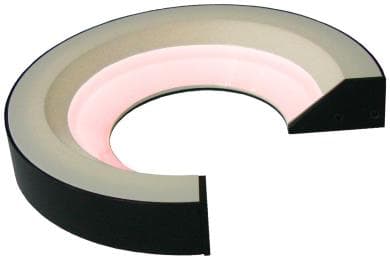
Falcon
FLKR-Si100-HC270-W
Area front light, Ø 98 mm, White
Price and availability on request
Falcon
FLKR-Si100-HC270-G
Area front light, Ø 98 mm, Green, 525 nm
Price and availability on request
Falcon
FLKR-Si100-HC270-B
Area front light, Ø 98 mm, Blue, 470 nm
Price and availability on request
Falcon
FLKR-Si100-HC270-R24
Area front light, Ø 98 mm, Red, 626 nm
Price and availability on request

Falcon
FLFL-Si15ST-IP67-W
Backlight, 15 × 15 mm, White
Price and availability on request

Falcon
FLFL-Si25-W
Backlight, 25 × 25 mm, White
Price and availability on request
Falcon
FLFL-Si25-G
Backlight, 25 × 25 mm, Green, 525 nm
Price and availability on request
Falcon
FLFL-Si25-B
Backlight, 25 × 25 mm, Blue, 470 nm
Price and availability on request
Falcon
FLFL-Si25-R24
Backlight, 25 × 25 mm, Red, 626 nm
Price and availability on request
Falcon
FLFL-Si25-IR
Backlight, 25 × 25 mm, Infrared, 850 nm
Price and availability on request

Falcon
FLFL-Si60-W
Backlight, 60 × 60 mm, White
Price and availability on request
Falcon
FLFL-Si60-G
Backlight, 60 × 60 mm, Green, 525 nm
Price and availability on request
Falcon
FLFL-Si60-B
Backlight, 60 × 60 mm, Blue, 470 nm
Price and availability on request
Falcon
FLFL-Si60-R24
Backlight, 60 × 60 mm, Red, 626 nm
Price and availability on request
Falcon
FLFL-Si60-IR24
Backlight, 60 × 60 mm, Infrared, 850 nm
Price and availability on request

Falcon
FLFL-Si60-3S-W
Backlight, 60 × 60 mm, White
Price and availability on request
Falcon
FLFL-Si60-3S-G
Backlight, 60 × 60 mm, Green, 525 nm
Price and availability on request
Falcon
FLFL-Si60-3S-B
Backlight, 60 × 60 mm, Blue, 470 nm
Price and availability on request
Falcon
FLFL-Si60-3S-IR24
Backlight, 60 × 60 mm, Infrared, 850 nm
Price and availability on request

Falcon
FLFL-Si70x40N-W
Backlight, 70 × 40 mm, White
Price and availability on request
Falcon
FLFL-Si70x40N-G
Backlight, 70 × 40 mm, Green, 525 nm
Price and availability on request
Falcon
FLFL-Si70x40N-B
Backlight, 70 × 40 mm, Blue, 470 nm
Price and availability on request
Falcon
FLFL-Si70x40N-R24
Backlight, 70 × 40 mm, Red, 626 nm
Price and availability on request
Falcon
FLFL-Si70x40N-IR24
Backlight, 70 × 40 mm, Infrared, 850 nm
Price and availability on request

Falcon
FLFL-Si70x40N-IP54-W
Backlight, 70 × 40 mm, White
Price and availability on request
Falcon
FLFL-Si70x40N-IP54-B
Backlight, 70 × 40 mm, Blue
Price and availability on request
Area lights cover both techniques: as a backlight they work in transmitted light and render the contour as a silhouette, while as flat front lighting they illuminate the surface from the camera side. With a backlight, the part sits between the light and the camera. The bright surface forms the background and the part appears as a silhouette, which suits outside dimensions, holes, gaps, presence and position. This arrangement tells you very little about surface features on the camera side. On transparent parts, edge contrast additionally depends on material, thickness and shape.
The active emitting area has to cover the whole field of view including the expected variation in part position. Use the emitting area given in the data sheet rather than the outer housing dimension, and check for brightness fall-off at the edges or visible LED structures using your final camera settings.
For dimensional inspection, even brightness is only part of the story. The gap between part and emitting surface, scattering within the material and the aperture you choose all shape the edge transition. Assess the combination together with your intended image resolution and measurement method. A larger light gives you headroom for changes in part position, but it is no substitute for checking edge sharpness and repeatability.
Area front lighting sits on the same side as the camera and reveals print, color, texture or near-surface defects. A large diffuse surface reduces individual harsh reflections, though it will not eliminate them on every shape. Models with a central aperture let the camera look through the light, so aperture diameter, lens dimensions, viewing angle and distance all have to match if you want to avoid shading or vignetting.
On flat, highly reflective surfaces, compare coaxial lighting as well. It guides directed light along the camera axis through a beam splitter and behaves quite differently from diffuse area lighting.
A flat dome spreads light from several directions across a shallow diffuse structure. That evens out reflections on slightly curved or irregular surfaces and saves installation height compared with a deep dome. The flat design does not match the solid-angle coverage of a classic dome light on every geometry, so test strongly curved, high-gloss or variably positioned parts in your intended setup.
Depending on the series, the range covers white, red, blue, green, infrared, UV and RGB versions. For contour inspection, monochromatic light with a matching filter delivers stable contrast. White light makes sense where color is evaluated or people judge the image. On transparent, fluorescent or coated materials, the name of a wavelength tells you nothing reliable about its effect.
Many models run on 24 V, while some strobe-capable versions explicitly require a constant-current or flash controller. IP rating, temperature range, cable and cooling vary by version as well, and large or bright surfaces have to shed enough heat in continuous operation. Derive the configuration from the exact part number rather than from general category information.
For a shortlist we need the part size, field of view, the side being inspected, working distance, installation space, motion and your intended exposure time, plus lens dimensions for front lighting with an aperture. Where reflection or transmission remains unclear, compare the arrangement on an original part in a feasibility study.
Next technical step
Send us a photo of the part, the view you need, the field of view and the working distance. We separate backlight, front light and flat dome first, then compare size, wavelength and control.
Request help choosing area lighting